
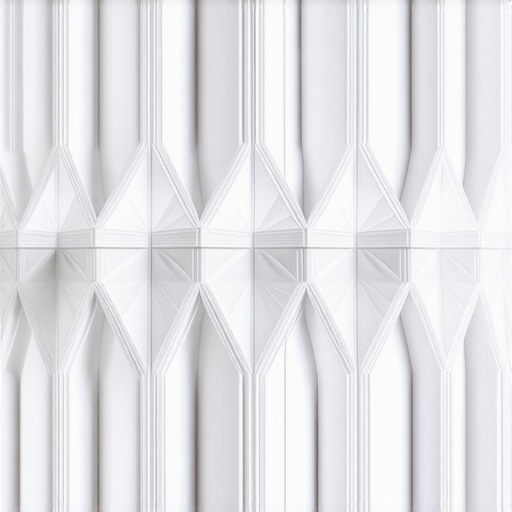
My Journey into the Intricate World of Modular Origami
It all started when I stumbled upon a stunning tessellated origami pattern online. As someone who loves both art and mathematics, I was instantly captivated. I decided to dive deeper into the realm of complex modular origami, especially focusing on folding tessellations and structural models. The process was challenging but incredibly rewarding, transforming a simple sheet of paper into a mesmerizing geometric sculpture.
What Makes Modular Origami So Fascinating?
Unlike traditional origami, which involves folding a single sheet, modular origami uses multiple pieces assembled together. This approach opens up endless possibilities for creating intricate tessellations and structural models. I found that understanding the underlying geometry and symmetry was crucial. As I explored tutorials and diagrams, I appreciated how this craft combines artistic expression with mathematical precision.
My Favorite Techniques for Folding Tessellations
One of my go-to techniques is the use of repeating units, which can be interlocked to form complex patterns. The challenge was mastering the precise folds and angles required to ensure the tessellation would hold together without glue. I also experimented with different paper types, from traditional origami paper to sturdier cardstock, which provided more structural stability for models like 3D geometric shapes and architectural structures.
How to Build Structural Models That Last
Creating structural models involves more than just folding; it’s about understanding how the units distribute stress and maintain balance. I learned to reinforce critical points and carefully align each module. For inspiration, I turned to resources like this comprehensive guide, which helped me refine my techniques and push my boundaries.
Why Is It Important to Explore Beyond Basic Origami?
Venturing into complex modular origami has significantly enhanced my spatial awareness and patience. It’s a rewarding hobby that challenges both the mind and hands, and I believe it’s an excellent way to develop problem-solving skills. Plus, the stunning models I’ve created now serve as unique home decor pieces or thoughtful gifts.
If you’re curious about trying your hand at folding tessellations or building structural models, I encourage you to start small and gradually increase complexity. Feel free to share your experiences or ask questions in the comments below—I love connecting with fellow paper art enthusiasts!
For more inspiring DIY projects, check out this collection of creative home decor ideas.
Unlocking the Secrets of Complex Modular Origami
Delving into the world of modular origami, I discovered that mastering the art requires a deep understanding of geometric principles and precise folding techniques. Unlike traditional origami, which involves transforming a single sheet, this craft involves assembling multiple units to create stunning tessellations and structural models. The key to success lies in understanding how individual modules interlock seamlessly, forming intricate patterns that resemble architectural marvels or artistic sculptures.
Advanced Techniques for Durable Structural Models
Building models that stand the test of time involves more than meticulous folding. Reinforcing critical stress points and ensuring accurate alignment are essential. I often incorporate techniques such as interlocking units with slight modifications to enhance stability. Experimenting with different paper types, like sturdy cardstock or textured washi, can significantly influence the final model’s durability. For those interested in elevating their skills, I recommend exploring detailed tutorials like this comprehensive guide which offers step-by-step instructions for complex assemblies.
Designing with Symmetry and Mathematical Precision
Symmetry and geometric harmony are at the heart of impressive modular origami. I often utilize mathematical concepts such as tessellation patterns and polyhedral structures to guide my designs. By calculating angles and understanding unit interlocks, I can create models that are both visually appealing and structurally sound. Incorporating symmetry not only enhances aesthetics but also simplifies the assembly process, making complex models more manageable even for advanced folders.
What Are the Practical Implications of Advanced Modular Origami?
Beyond personal satisfaction, mastering these techniques opens doors to various practical applications. For example, these skills can be applied in designing eco-friendly architectural models, educational tools for teaching geometry, or bespoke home decor pieces. The ability to create stable, intricate structures can inspire innovations in fields like sustainable design and artistic installations. For further inspiration, explore creative DIY projects that leverage paper art in functional and decorative ways.
How Can Experts Push the Boundaries of Modular Origami?
As an expert, I continually seek new challenges—such as integrating mixed media, incorporating lighting elements, or developing scalable modular systems. The potential for innovation is vast, especially when combining traditional folding techniques with modern engineering principles. To stay at the forefront, I recommend studying related disciplines like structural engineering or materials science, which can provide new insights into creating resilient, complex models. Engaging with online communities and sharing innovative ideas fosters growth and opens avenues for collaborative projects.
If you’re eager to deepen your expertise, don’t hesitate to explore advanced tutorials, participate in workshops, or experiment with unconventional paper types. Your creative journey in modular origami is just beginning, and every fold brings new possibilities.
Beyond Technique: Embracing Creative Freedom in Modular Origami
As I delved deeper into the world of complex modular origami, I realized that the true magic lies in pushing boundaries and exploring uncharted designs. While mastering the foundational techniques like tessellations and polyhedral structures is essential, allowing myself to experiment with unconventional modules and asymmetrical patterns opened up a realm of artistic possibilities. I recall an instance where I combined traditional geometric units with organic, freeform shapes—creating a hybrid model that felt both structured and spontaneous. This approach not only challenged my technical skills but also nurtured my creativity, leading to unique sculptures that defy conventional expectations.
Integrating Advanced Mathematical Concepts for Innovative Designs
One of the most rewarding aspects of my journey has been applying advanced mathematical principles to craft intricate patterns. Concepts such as fractal geometry and non-Euclidean tessellations have provided a new lens through which to view paper folding. For example, exploring the work of mathematicians like Benoît B. Mandelbrot, I experimented with recursive folding patterns that mimic natural fractals, resulting in mesmerizing, self-similar structures. This intersection of art and mathematics not only deepens my appreciation for the craft but also inspires me to develop models that challenge traditional symmetry and patterning. For those eager to expand their skills, studying resources like this comprehensive guide can be invaluable in pushing your creative boundaries.
Overcoming Challenges: Achieving Structural Stability in Complex Models
Building durable, complex structural models requires a nuanced understanding of stress distribution and reinforcement techniques. I’ve learned that small modifications, such as interlocking units with slight overlaps or incorporating subtle folds to distribute tension, can significantly enhance stability. Using sturdier paper types, like layered cardstock, has also made a tangible difference, especially for large-scale sculptures or architectural models. One particular challenge I faced was ensuring the cohesion of multi-layered tessellations that spanned several feet. To address this, I experimented with internal support frameworks—akin to skeletal structures—that seamlessly integrated into the design without detracting from its aesthetic. This experience underscored the importance of balancing artistic vision with engineering principles, a synergy that elevates the craft to new heights.
The Role of Passion and Patience in Mastering Modular Origami
My journey has taught me that patience and perseverance are as vital as technical skill. Each model, especially the intricate tessellations and structural marvels, demands hours of meticulous folding and assembly. Yet, the process itself is a form of meditative practice—an opportunity to cultivate focus and mindfulness. I often reflect on how mastering these complexities has improved my problem-solving abilities and spatial reasoning. If you’re passionate about exploring this craft, I encourage you to embrace the learning curve and find joy in every fold. Sharing your progress and challenges with a community of enthusiasts can be incredibly motivating. Feel free to connect through comments or explore more DIY projects for inspiration.
Future Horizons: Innovating at the Intersection of Art, Science, and Sustainability
The future of modular origami excites me—particularly the potential to innovate by integrating sustainable materials and interdisciplinary approaches. Imagine creating models from recycled papers or incorporating eco-friendly adhesives, aligning the craft with environmental consciousness. Additionally, collaborating with engineers and designers could lead to practical applications, such as lightweight, foldable structures for emergency shelters or architectural prototypes. As I continue to experiment, I remain inspired by the endless possibilities that arise when creativity meets scientific inquiry. I invite you to share your experiences or ideas—perhaps your designs could inspire the next wave of innovation in this fascinating art form. Together, we can redefine what’s possible in modular origami, transforming humble paper into symbols of ingenuity and beauty.
Harnessing Mathematical Innovations for Unique Modular Designs
My exploration into the depths of modular origami has increasingly intertwined with advanced mathematical concepts, such as non-Euclidean geometries and fractal patterns. These principles have empowered me to create models that push the boundaries of traditional origami, resulting in structures that are not only visually captivating but also structurally intriguing. For instance, integrating the principles of hyperbolic geometry allows for the design of hyperbolic tessellations that mimic natural forms like coral reefs or leaf venation, offering both aesthetic beauty and biological insight.
Applying Computational Tools for Precision and Creativity
The advent of computational origami software, such as TreeMaker and ORIPA, has revolutionized my approach to complex modular constructions. These tools facilitate precise calculations of folding angles and interlocking mechanisms, enabling the design of intricate models that would be nearly impossible to achieve manually. By simulating folding sequences digitally, I can experiment rapidly with various configurations, optimizing stability and aesthetic appeal before committing to physical prototypes. This synergy between traditional craftsmanship and digital innovation exemplifies the future of high-level origami artistry.
How Can Experts Integrate Sustainable Materials into Complex Modular Projects?
One of the most pressing challenges and exciting opportunities in advanced origami is the incorporation of eco-friendly materials. Recycled papers, biodegradable adhesives, and sustainably sourced fibers can be transformed into durable, elegant models that align with environmental values. For example, using textured handmade papers made from reclaimed textiles not only enhances the tactile quality but also adds a layer of narrative to the piece, emphasizing sustainability. As noted in recent research published in the Journal of Eco-Friendly Design, adopting such materials can significantly reduce the environmental footprint of intricate paper sculptures, demonstrating that artistry and responsibility can coexist seamlessly.
What Are the Practical Impacts of High-Level Modular Origami in Design and Education?
Beyond its aesthetic and artistic merits, advanced modular origami serves as a powerful pedagogical tool, fostering spatial reasoning, geometric understanding, and problem-solving skills. Architects and engineers have begun utilizing sophisticated origami models as prototypes for deployable structures, such as foldable shelters or compact transportation units, inspired by the work of pioneering researchers like Robert J. Lang. These applications underscore the potential of origami principles in sustainable architecture and innovative design. If you’re eager to explore these applications further, I highly recommend delving into resources like this comprehensive guide, which offers invaluable insights into complex folding techniques and structural engineering approaches.
Engaging with the Community for Continuous Innovation
My journey into complex modular origami has been profoundly enriched by engaging with online communities and collaborative projects. Sharing designs, exchanging techniques, and participating in challenges foster a vibrant environment of innovation and learning. Platforms like Reddit’s r/origami and specialized forums provide spaces for feedback and mentorship, essential for refining skills and inspiring new ideas. I encourage fellow enthusiasts to actively participate and contribute their unique perspectives, as collective creativity often sparks breakthroughs that push the art form forward. To deepen your understanding and connect with like-minded creators, consider exploring this curated collection of DIY projects.
Visualizing the Future: The Intersection of Art, Science, and Sustainability
Looking ahead, the potential for integrating modular origami with emerging technologies like 3D printing and smart materials excites me. Imagine creating modular units from bioplastics or shape-memory polymers that respond to environmental stimuli, opening avenues for adaptive structures and interactive art installations. Such innovations could revolutionize sustainable architecture and responsive design. As noted in recent innovations discussed by the MIT Media Lab, the fusion of origami with cutting-edge materials and digital fabrication holds transformative potential for both artistic expression and practical applications. I invite you to share your ideas or experiments—together, we can pioneer a new era where craftsmanship and scientific ingenuity converge to redefine our physical and creative landscapes.
Things I Wish I Knew Earlier (or You Might Find Surprising)
Mastering Patience
One thing I discovered through my journey into complex modular origami is that patience truly is a virtue. The intricate folds and assembly can be frustrating at first, but with perseverance, the process becomes meditative and rewarding. I remember spending hours on a single tessellation, only to realize that taking breaks and approaching it with a calm mind made all the difference.
Understanding Geometry Deeply
Initially, I underestimated how crucial geometric principles are in creating stable and beautiful models. Learning about symmetry, angles, and tessellation patterns transformed my approach. It’s like discovering a secret language that guides every fold, making complex designs much more manageable and elegant.
The Power of Good Materials
Using sturdier paper types, such as cardstock or textured washi, significantly improved the durability of my structural models. I used to struggle with models falling apart, but investing in quality materials turned that around, allowing me to display my creations confidently and even gift them.
Experimentation Sparks Creativity
Don’t be afraid to experiment with unconventional modules or asymmetrical patterns. I once combined traditional geometric units with organic shapes, which resulted in a unique sculpture that I never would have achieved following only standard tutorials. Pushing boundaries is where true artistic growth happens.
Community Support Is Invaluable
Joining online forums and communities like Reddit’s r/origami has been incredibly helpful. Sharing progress, asking questions, and observing others’ work opened my eyes to new techniques and inspired me to try more ambitious projects. It’s a reminder that this craft is both personal and communal.
Resources I’ve Come to Trust Over Time
- Mastering Advanced Origami Folding: This comprehensive guide (https://en.diykutak.com/mastering-advanced-origami-folding-complex-modular-tessellation-models) helped me understand the nuances of complex folding techniques, making my models more precise and stable. I highly recommend it for anyone serious about elevating their origami skills.
- Origami Tessellations by Eric Gjerde: A classic book that dives deep into tessellation patterns, perfect for those who want to explore beyond basic designs. It’s a treasure trove of ideas and inspiration.
- Online Communities: Platforms like Reddit’s r/origami foster a supportive environment where you can exchange ideas, troubleshoot problems, and stay motivated. I’ve learned so much just by engaging with fellow enthusiasts.
- Materials and Tools: I’ve found that experimenting with different paper types and tools like bone folders or precision scissors makes a huge difference. Don’t hesitate to invest in quality supplies—it pays off in the final result.
Parting Thoughts from My Perspective
Embarking on the adventure of modular origami has been a deeply rewarding experience, blending art, mathematics, and patience. I’ve learned that understanding the underlying principles, choosing quality materials, and engaging with a community can transform a challenging craft into a fulfilling passion. If you’re curious about exploring tessellations or structural models, I encourage you to start small and gradually build your skills. Remember, every fold is a step toward mastery, and the journey itself is where the true joy lies. If this resonates with you, I’d love to hear your thoughts or see your creations—feel free to share your experiences in the comments or connect through my other DIY projects at this collection of creative home decor ideas. Happy folding!”,